
Healthy gardens depend on a delicate balance of organisms, including fungi and bacteria. While many fungi are beneficial and help plants thrive, others can cause serious diseases that weaken plants, reduce yields, spoil their appearance, and even lead to plant death. Maintaining healthy plants, therefore, requires a balanced approach that supports beneficial organisms while effectively controlling harmful diseases.
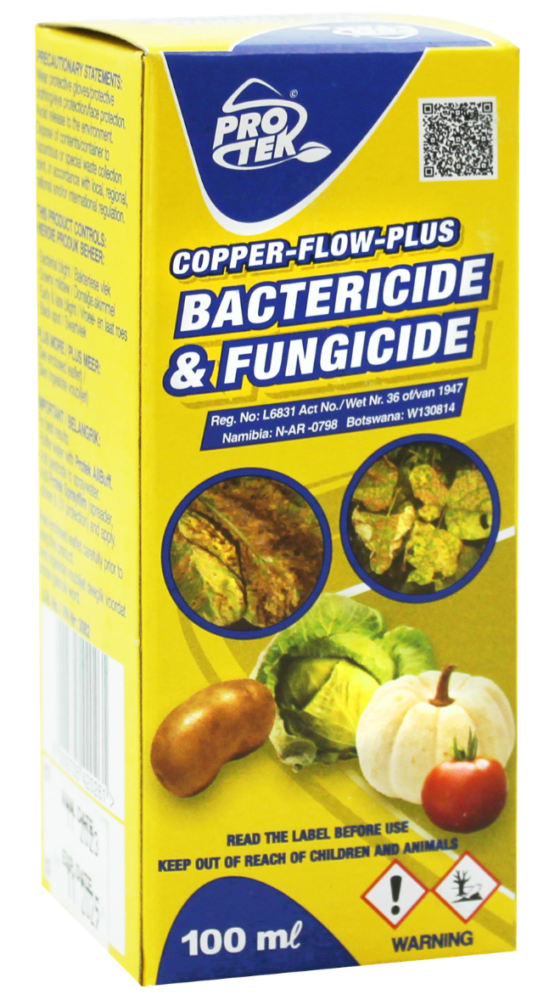 Beneficial fungi form important symbiotic relationships with plant roots, improving water and nutrient uptake, while helping to break down organic matter and improve soil structure. These naturally occurring fungi contribute significantly to healthy soil and vigorous plant growth. However, harmful fungi and bacteria can attack leaves, stems, fruit, flowers and roots, causing diseases to spread rapidly under favourable conditions. Warm temperatures, high humidity, poor airflow and excessive moisture create ideal conditions for fungal and bacterial diseases to develop, and spread throughout the garden.
Protek Copper-Flow-Plus is a contact fungicide and bactericide that provides effective protection against a wide range of common plant diseases. It forms a protective barrier on plant surfaces, helping to prevent fungal spores and bacteria from establishing and spreading.
Regular preventive applications are particularly important during warm, humid, or rainy conditions, when disease pressure is high. Early treatment and consistent monitoring can significantly reduce the spread and severity of infections.
Common Plant Diseases
Rust is a fungal disease which affects many ornamental plants, vegetables, fruit trees and roses. It appears as powdery orange, yellow, or rusty-brown spots on leaves and stems. Infected leaves may yellow, dry out and drop prematurely, weakening the plant.
Black Spot commonly affects roses and other ornamentals in warm, humid weather. It causes dark brown or black spots, surrounded by yellowing tissue on leaves. Severe infections lead to leaf drop, reduced plant vigour and flowering.
Downy Mildew thrives in cool, damp conditions and appears as pale yellow patches on the upper leaf surfaces, with grey or purplish fungal growth on the undersides of the leaves. It spreads rapidly in wet weather and can severely damage vegetables, ornamentals, and vines.
Early and Late Blight commonly affect tomatoes and potatoes. Early blight causes dark, concentrically ringed spots on leaves and stems, while late blight spreads rapidly in cool, wet conditions and can destroy foliage and fruit in a short period.
Cercospora Leaf Spot causes circular or irregular brown lesions on leaves, often with yellow halos. Severe infections reduce photosynthesis and weaken plants.
Anthracnose affects a wide range of plants and often appears as dark, sunken lesions on leaves, stems, flowers or fruit. Wet conditions promote rapid spread.
Bacterial blight, bacterial spot and bacterial speck cause water-soaked lesions, spotting, wilting and tissue collapse on leaves and fruit. These diseases spread readily via splashing water, contaminated tools, and infected plant material.
Scab and Sooty Blotch primarily affect fruit trees. Scab produces rough, corky lesions on fruit and leaves, whereas sooty blotch creates dark, superficial markings on fruit surfaces, reducing quality and appearance.
Preventing Fungal and Bacterial Diseases
Good garden management is vital to disease prevention. Combining sound gardening practices with preventative treatments helps keep plants healthy and resilient.
Top tips:
- Space plants according to their mature size to avoid overcrowding. Thin dense growth and prune plants where necessary to improve airflow and allow sunlight to reach the canopy. Good ventilation helps foliage dry more quickly after rain or irrigation, reducing conditions favourable to disease development.
- Water early in the morning, this allows foliage to dry during the day. Avoid overhead irrigation where possible and water the soil around the root zone. Excess moisture on leaves encourages fungal and bacterial diseases, while waterlogged soil can lead to root diseases and plant stress.
- Remove and destroy infected leaves, fruit and plant material promptly. Do not add diseased material to compost heaps. Regularly clear away weeds and garden debris, as fungal spores and bacteria may survive and multiply there.
- Pruning shears, secateurs, lawnmowers and trimmers can spread plant diseases. Clean and disinfect tools regularly, especially after working on infected plants. Dry equipment before storing to prevent rust and contamination.
- Certain insects, such as aphids, can spread plant diseases by transmitting fungal spores and bacteria between plants. Inspect plants regularly and control insect infestations when necessary.
- Regular inspection is one of the most effective ways to prevent serious disease outbreaks. Watch for warning signs such as leaf spots, yellowing, wilting, discolouration, mould growth, or unusual lesions – act quickly at the first sign of infection to prevent diseases from spreading throughout the garden.
Integrated Pest Management for long-term garden health
Effective disease control is best achieved through an Integrated Pest Management (IPM) programme. IPM combines preventive cultural practices, regular monitoring, biological balance, sanitation, resistant plant varieties, and responsible use of crop protection products to minimise disease pressure while supporting a healthy garden.
IPM focuses on preventing problems before they occur, applying Protek Copper-Flow-Plus preventatively and strategically when conditions favour disease development will assist with this. This balanced approach helps reduce plant stress, improves long-term garden health and promotes stronger, more resilient plants throughout the growing season.
Registered in terms of Act 36 of 1947
READ THE LABEL BEFORE USING THE PRODUCT
Copper-Flow-Plus: L6831, copper ammonium acetate 315 g/l, WARNING, H302 – harmful if swallowed, H313 – may be harmful in contact with skin, H335 – may cause respiratory irritation, H400 – very toxic to aquatic life, registration holder: UPL South Africa (Pty) Ltd, company registration number: 2009/019713/07, 7 Sunbury Office Park, Off Douglas Saunders Drive, La Lucia, 4019, telephone number: 031 514 5600
Distributed by: Protek, a division of PE-BEE Agri (Pty) Ltd, PO Box 72, Heidelberg,1438, telephone number (011) 812-9800 or 0861 PROTEK (0861 77 68 35), www.protek.co.za