
Psylla may be small, but this garden pest has a big impact on your plants’ health. Although it may appear harmless, psylla can be highly destructive to plants due to its feeding habits. These sap-suckers settle onto plants and use their mouthparts like miniature straws to tap into the sap. As they feed, they leave behind a sticky residue creating a mess that invites even more trouble for your plants.
Psylla is a particularly serious pest on citrus trees. Its feeding can cause significant damage to new growth and buds, resulting in stunted growth, reduced yields, and malformed, curled leaves. Cavities or bumps may appear on the leaves, further indicating their presence.
One of the first signs of psylla infestation is the characteristic yellow eggs laid along the edges of young leaves, followed by the formation of these cavities or bumps on the opposite side of the leaf.
Another noticeable sign of a psylla infestation is the sticky residue they leave behind, called honeydew. This sugary coating opens the door to secondary problems. Sooty mold follows, forming a black layer that blocks sunlight and hampers photosynthesis. Ants are also attracted to the honeydew and will protect psylla from its natural enemies, worsening the infestations. Plants already weakened by psylla become more vulnerable to other pests, turning a minor issue into a broader plant health problem. Effective psylla control is not just about killing the insect – it is about stopping the domino effect caused by the honeydew. Get rid of the pest population early by checking the undersides of leaves for nymphs and the tell-tale sticky shine. Once detected, apply a pesticide to target immature states, which are easier to control than adults.
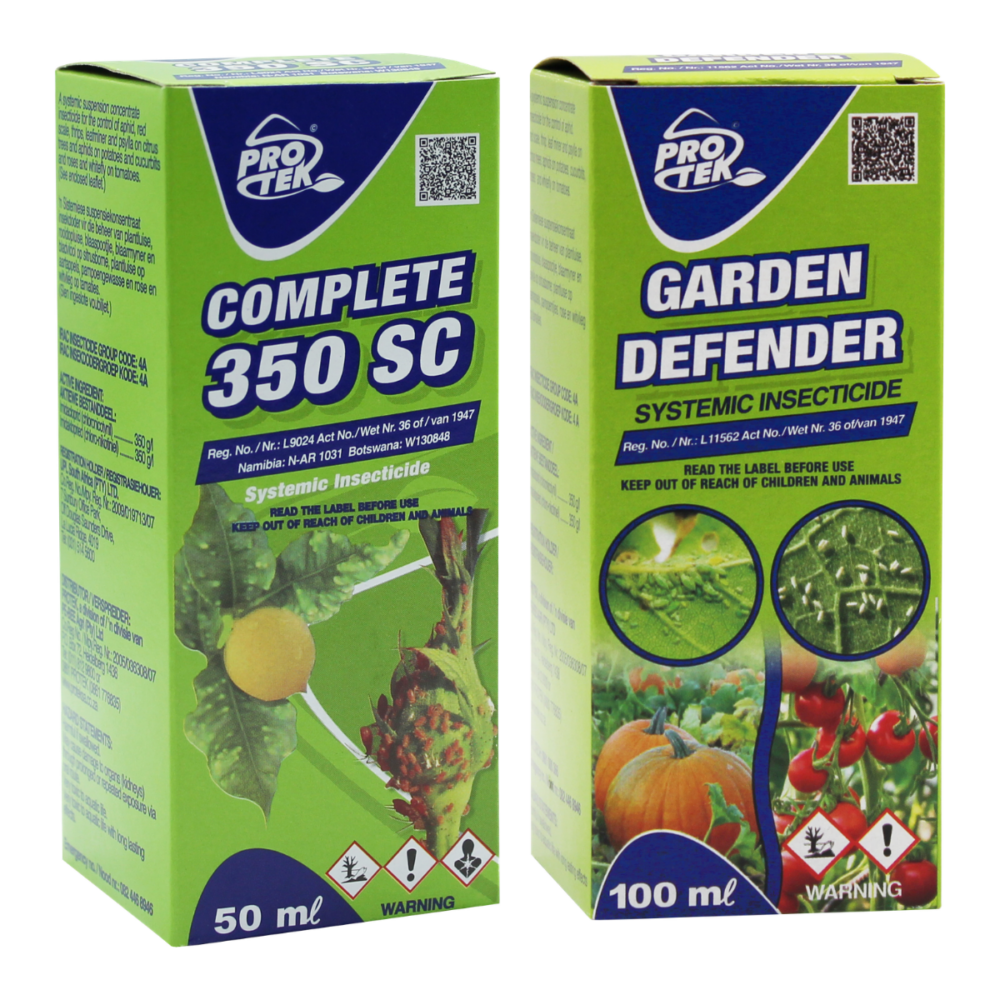
Complete 350SC and Garden Defender are systemic garden insecticides with long lasting action for the control of sucking and biting insects such as psylla. Both products are used as an easy, seasonal soil drench applied to the root area of the plant and used as preventative and corrective control of pests. Read and follow the instructions carefully for effective and safe use.
Also control ants aggressively as they protect psylla from their natural enemies in exchange for honeydew. If ants are present, your control efforts will be undermined.
In short, control the psylla, ensuring that there is not a build up of honeydew, and cut off the ants, otherwise the problem keeps rebuilding itself.
Registered in terms of Act 36 of 1947
READ THE LABEL BEFORE USING THE PRODUCT
Complete 350 SC: L7959, imidacloprid (chloro-nicotinyl) 350 g/l, WARNING, H302 – harmful if swallowed, H373 – may cause damage to organs (kidneys) through prolonged or repeated exposure via oral route, H400 – very toxic to aquatic life, H410 – very toxic to aquatic life with long lasting effects, registration holder: UPL South Africa (Pty) Ltd, company registration number: 2009/019713/07, 7 Sunbury Office Park, Off Douglas Saunders Drive, La Lucia, 4019, telephone number: 031 5145600
Garden Defender: L11562, imidacloprid (chloro-nicotinyl) 350 g/l, WARNING, H302 – harmful if swallowed, H373 – may cause damage to organs (kidneys) through prolonged or repeated exposure
via oral route, H400 – very toxic to aquatic life, H410 – very toxic to aquatic life with long lasting effects, registration holder: Protek, a division of PE-BEE Agri (Pty) Ltd, company registration number: 2005/036 308/07, PO Box 72, Heidelberg, 1441, telephone number: 011 812 9800
Distributed by: Protek, a division of PE-BEE Agri (Pty) Ltd, PO Box 72, Heidelberg,1438, telephone number (011) 812-9800 or 0861 PROTEK (0861 77 68 35), www.protek.co.za